



If you searched for Yonopress and landed on yonopress com, you may be wondering what the website actually is. Is it a news website, a general information blog, a specialist platform, or something else?
The answer becomes clearer when you look at the website itself rather than relying on descriptions from unrelated pages. Yonopress com presents itself as an online publication and digital content platform covering a wide range of subjects, including technology, business, education, finance, health, lifestyle, travel, and fashion.
What Is Yonopress?
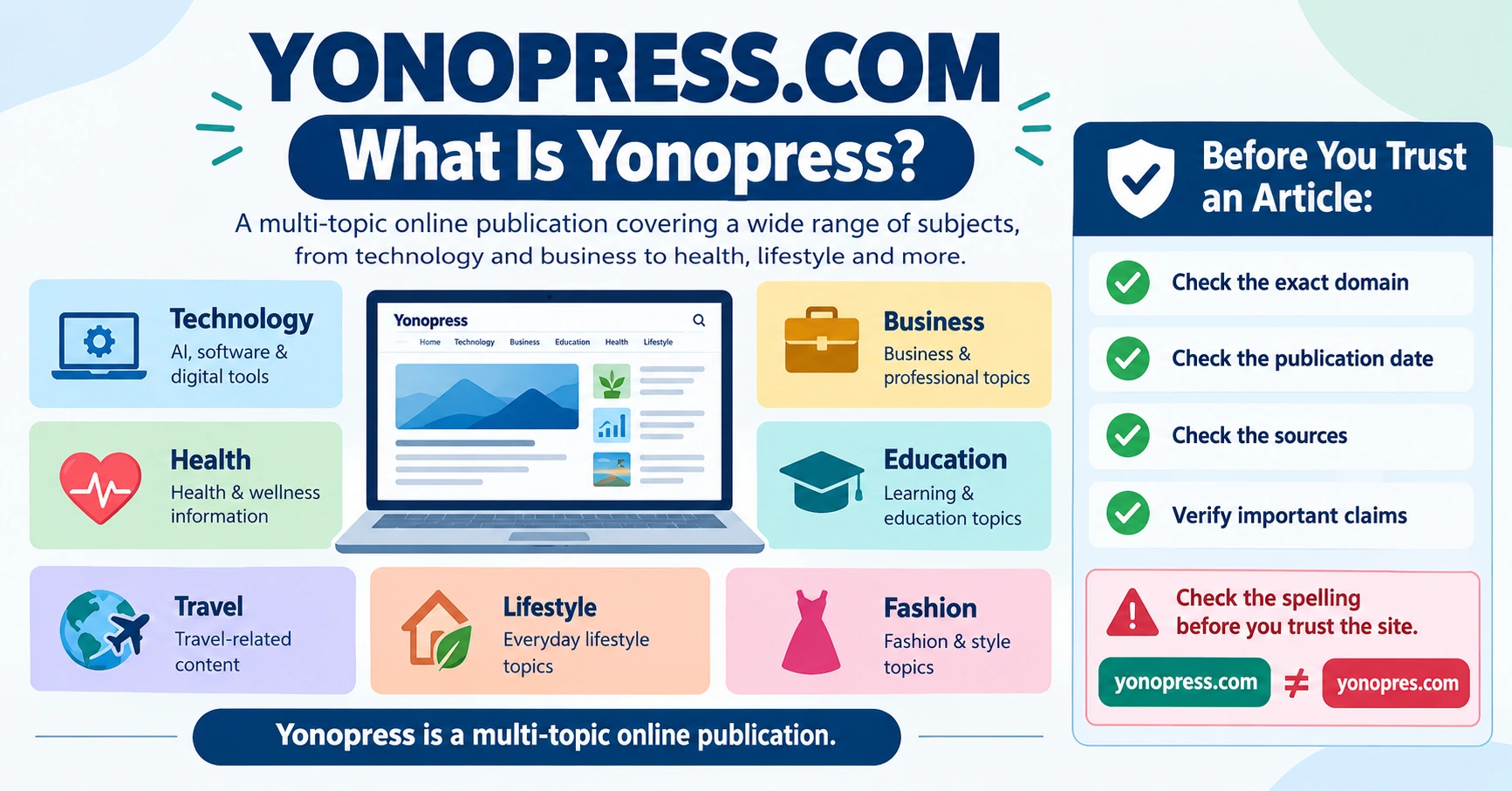
Yonopress is a multi-topic online publication available at yonopress com. According to its About Us page, the website was created for readers looking for useful information, practical ideas, and engaging stories in one place.
Unlike a website dedicated to one narrow subject, Yonopress publishes content across several categories. Its site navigation and content include areas such as:
- Technology
- Business
- Education
- Finance
- Health
- Lifestyle
- Travel
- Fashion
- SEO
- AI
- Literature
- Pets
The homepage also contains a mixture of informational guides, explainers, trend-related articles, and general-interest content.
That means someone searching for “Yonopress” is generally trying to identify what the website is and what kind of information it provides, rather than looking for a single product or service.
What Does Yonopress Publish?
The easiest way to understand Yonopress is to look at the subjects it publishes.
Technology and AI
The technology section covers subjects such as artificial intelligence, software, digital tools, online services, and technology-related trends.
The site has published content involving AI tutors, smart furniture, knowledge-management software, and other technology topics.
This makes the technology section useful for readers looking for general explanations rather than content limited to one particular technology company or product.
Business and Finance
Yonopress also publishes business and finance content.
Examples include subjects involving internet infrastructure, customer communication, payroll providers, freelancer cash flow, insurance, and other business-related topics.
Because these subjects can involve financial or business decisions, readers should evaluate individual articles according to their sources, publication date, and the specific claims being made.
Education
The education category contains learning-related articles and guides. Content includes subjects involving digital minimalism, AI in education, augmented and virtual reality, and other educational topics.
So if your search brought you to Yonopress through an education-related article, the site is not necessarily focused exclusively on education. Education is one part of its broader publishing model.
Health and Lifestyle
The website also has health and lifestyle sections covering topics intended for general readers.
Its health content includes subjects such as nutrition, vitamin deficiencies, sleep, and men’s mental health, while lifestyle content covers broader everyday interests.
For health-related information, it is important to distinguish general educational content from professional medical advice. An article appearing on a general-interest publication should not automatically be treated as a substitute for guidance from a qualified healthcare professional.
Why Does Yonopress Cover So Many Different Topics?
This is one of the easiest things to misunderstand about the site.
Yonopress does not present itself as a specialist publication focused on one industry. Its About Us page describes it as a digital media and content platform covering a diverse range of subjects and interests.
The broad category structure reflects that positioning.
Instead of visiting Yonopress for only technology, only finance, or only education, readers can encounter different types of informational content on the same domain.
That also means you should judge an article based on the specific topic and evidence in that article, rather than assuming that everything published on the domain has the same level of expertise.
Is Yonopress the Same as Other Websites Using the Name?
This is an important point if you searched for Yonopress because you saw conflicting descriptions online.
There are references on the web to websites using very similar Yonopress names and domains. Some third-party pages describe a different yonopres.com domain as a financial-services platform, while yonopress com itself presents as a multi-topic publication.
The difference in the domain matters:
- yonopress com — the website discussed in this article, presenting itself as a multi-topic online publication.
- yonopres.com — a different domain that has been described elsewhere as a platform involving payroll, banking, travel insurance, and other financial services.
These should not be treated as the same website simply because their names look similar.
This is particularly important before entering personal, financial, or login information. Always check the exact spelling of the domain in your browser.
How Can You Verify You Are Looking at the Correct Yonopress?
If several search results use similar names, take a few seconds to verify the domain.
1. Check the Exact URL
Look at the browser address bar.
The website discussed here is:
yonopress com
A missing or additional letter can lead you to a completely different website.
2. Check the Site’s Own Description
The Yonopress About page describes the site as an online publication covering topics including business, finance, education, fashion, and other areas.
If another website claims that Yonopress is primarily a bank, payroll provider, SEO software company, or another type of service, check its domain before assuming the information applies to yonopress com.
3. Check the Category Structure
The actual Yonopress website provides categories covering technology, business, education, finance, health, lifestyle, travel, and related subjects.
The site’s navigation can therefore give you a useful indication of what it currently publishes.
4. Check the About and Contact Information
Yonopress has an About Us page explaining its publishing purpose and provides contact information for questions, corrections, suggestions, and business inquiries.
That information can help distinguish the real domain from similarly named websites.
What Should You Check Before Trusting a Yonopress Article?
Finding the correct website is only the first step.
Because Yonopress covers many unrelated subjects, the reliability of a particular article should be considered on its own merits.
Before relying on an article, ask:
- Who wrote the article?
- When was it published or updated?
- Does it cite primary or authoritative sources?
- Are important claims supported by evidence?
- Is the topic one where outdated information could cause problems?
- Does the article clearly separate facts from opinions or general advice?
- Can important claims be confirmed independently?
This matters particularly for health, finance, legal, technology-security, and other high-impact subjects.
A general-interest publication can provide a useful starting point, but readers should verify important decisions against appropriate authoritative sources.
How Should You Use Yonopress?
If you are using Yonopress to research a topic, the most useful approach is to treat it as a starting point for information rather than assuming that every article is equally authoritative.
Start with the article that matches your question, then look at its supporting details. Check the publication information, author information when available, cited sources, and the date of the content.
For general-interest topics, this may be enough to understand the subject. For information that could affect your health, finances, security, or other important decisions, take an additional verification step.
The goal is not simply to find an article that answers your question. It is to determine whether the information in that article is appropriate for the decision you are trying to make.
How Can You Tell Whether Information on Yonopress Is Current?
The publication date matters because some subjects change quickly.
Technology, artificial intelligence, financial products, online services, regulations, and other time-sensitive subjects can become outdated even when an article was accurate when published.
Before relying on an article, check:
- Publication or update date — determine how old the information is.
- Specific claims — identify statements that depend on current conditions.
- Sources — check whether the article refers to authoritative or primary information.
- Current alternatives — if the subject changes frequently, compare important details with the relevant official source.
- Context — make sure information written for one situation or location actually applies to yours.
This simple process can prevent an old article from being mistaken for current guidance.
What Should You Do If a Yonopress Article Makes a Claim You Cannot Verify?
Do not automatically treat an unsupported statement as false, but do not automatically treat it as established fact either.
Instead, classify the information into three practical categories.
Verified Information
The claim can be supported by a reliable source or by the primary source being discussed.
Reported or Attributed Claim
The article reports something said by a company, organization, expert, or another third party.
In this case, it is useful to distinguish between “X says…” and “It has been independently established that…”
Information That Needs Verification
If an important claim cannot be confirmed from reliable sources, treat it cautiously until you can verify it.
This distinction is particularly useful when researching products, companies, financial services, health topics, or websites with similar names.
What If You Found Yonopress Through a Search Result?

A search result does not necessarily tell you everything about the website behind it.
If your search result points to an article on Yonopress, first make sure the URL is actually yonopress com. Then read enough of the article to understand what claim or question it is addressing.
If you are researching a company, service, product, or online platform, also visit the relevant official source where possible.
For example, if an article discusses a particular software product, the product’s own documentation may provide more authoritative information about current features. If an article discusses a financial service, the relevant provider or regulator may be the better source for current terms.
This approach helps you use Yonopress as part of your research without confusing secondary information with primary documentation.
Does Yonopress Replace an Official Source?
Not necessarily.
The appropriate source depends on what you are trying to establish.
For a general explanation, an online publication can help you understand a subject in accessible language. But when you need an exact current rule, price, policy, specification, eligibility requirement, medical recommendation, or legal requirement, the relevant official or professional source should generally be checked as well.
Think of the process this way:
Yonopress article → understand the topic → identify the important claim → verify it with the appropriate primary or authoritative source.
That is more useful than treating any single article as the final authority on every subject.
When Should You Be Especially Careful?
Extra verification is sensible when an article concerns:
- Financial decisions or financial services
- Medical conditions, treatments, or supplements
- Legal requirements
- Cybersecurity or account security
- Current regulations
- Product specifications that may change
- Prices, fees, or subscriptions
- Company claims
- Websites or services with confusingly similar domains
The reason is straightforward: mistakes in these areas can have consequences beyond simply misunderstanding an article.
How Can You Avoid Confusing Yonopress With a Similar Domain?
The safest habit is to check the complete domain every time.
Do not rely only on the name shown in a search result, social-media post, advertisement, or third-party article.
Pay attention to:
- The exact spelling
- The domain extension
- Extra or missing letters
- The page’s About information
- Whether the site’s description matches the service you expected
- Whether links lead to the organization you intended to visit
A website with a nearly identical name can belong to a completely different organization.
If you are about to create an account, submit personal information, make a payment, or provide financial details, verify the domain before continuing.
Can You Use Yonopress for Research?
Yes, but the appropriate use depends on the research question.
For general discovery, Yonopress can help you find explanations and identify subjects worth exploring.
For deeper research, use the article as one source and follow important claims back to stronger primary or authoritative sources.
For high-stakes decisions, do not stop with a general-interest article. Verify the relevant information independently.
This approach gives you the practical benefit of accessible content while reducing the risk of relying on information without sufficient context.
Frequently Asked Questions About Yonopress
Is Yonopress a news website?
Yonopress presents itself as an online publication covering a broad range of subjects. Its content includes informational and general-interest articles rather than being limited to one specialist news category.
What topics does Yonopress cover?
The site covers multiple categories, including technology, business, education, finance, health, lifestyle, travel, fashion, SEO, AI, literature, and pets.
Is yonopress com the same as yonopres.com?
No. The domains have different spellings and should be treated as separate websites unless there is reliable evidence establishing a connection.
How do I know I am visiting the correct Yonopress website?
Check the browser address bar and confirm that the domain is spelled yonopress com. Do not rely solely on the website name displayed in a search result.
Can I rely on every Yonopress article for important decisions?
Important claims should be evaluated according to the subject and evidence supporting them. For health, financial, legal, security, and other high-impact topics, verify relevant information with appropriate authoritative or primary sources.
Why does Yonopress have so many different categories?
Yonopress describes itself as a broad digital publication rather than a specialist website dedicated to one subject. Its multi-category structure reflects that publishing approach.
What should I check before trusting information from a website?
Check the exact domain, publication date, author information when available, supporting sources, and whether important claims can be independently verified. The more consequential the decision, the more important independent verification becomes.
Final Takeaway
If you searched for Yonopress, the most important thing to understand is that yonopress com presents itself as a broad online publication rather than a single-purpose website.
Its content spans several areas, so the right way to evaluate something you read there is to focus on the specific article, its evidence, its date, and the nature of the claim.
The other important issue is domain confusion. Similar-looking website names can refer to completely different services, so always check the exact URL before assuming that information about one domain applies to another.
For ordinary informational searches, Yonopress can be a useful place to begin. When the information affects an important decision, use the article as a starting point and verify the critical details with the appropriate primary or authoritative source.
That simple approach answers the two practical questions behind most searches for Yonopress: what is this website, and how should I evaluate the information I find there?


Comments are closed