



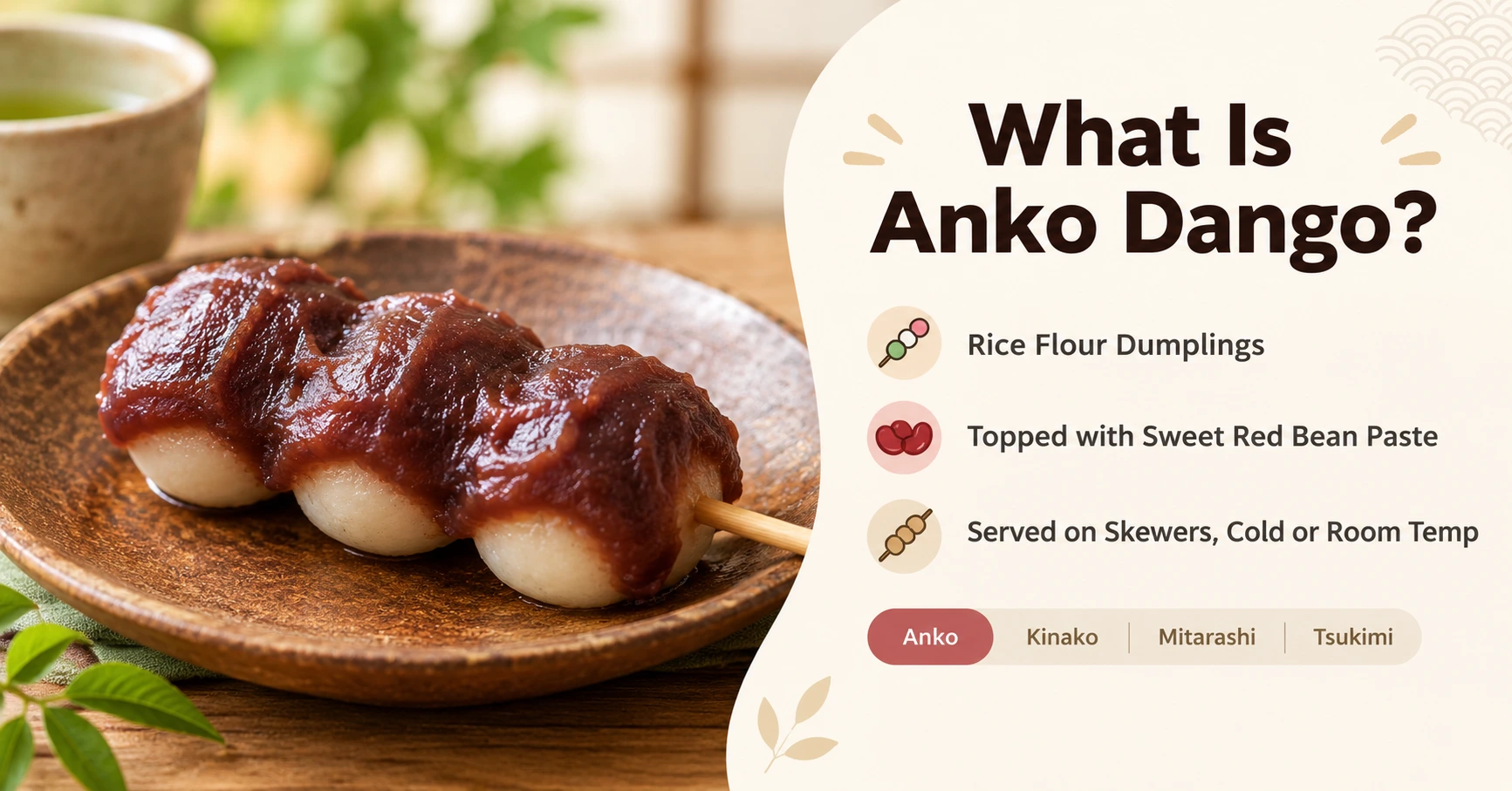
Did you search “anko dango near me” and get nothing but confusing restaurant listings? You’re not alone. Anko dango is a specific Japanese sweet. Most search tools don’t recognize the name right away. Even some store staff won’t know it by that exact term.
This guide explains what this sweet actually is. It shows you where stores realistically sell it. It also shows you how to search so you get useful results instead of a blank map. By the end, you’ll know exactly what to look for and where to find it.
Do you not know what it looks like? Are you unsure whether the “dango” at your local Asian grocery store is the same thing? Did your Maps search come up empty? This guide covers all of that, starting with what the term actually means.
What Anko Dango Actually Is
Anko dango is a Japanese sweet. Small, chewy rice-flour dumplings called dango carry a topping of anko, or sweetened red bean paste. It belongs to a wider category of traditional Japanese confections called wagashi, which also includes mochi and other rice-and-bean-based sweets. Most other dango varieties mix the flavoring inside the dumpling. This one works differently — the red bean paste sits thickly on top. You get a smooth, slightly sweet layer over a soft, chewy dumpling.
Stores usually serve it on skewers, with three to five balls per stick. People eat it cold or at room temperature, not hot.
Anko Dango vs. Kinako, Mitarashi, and Tsukimi Dango
A lot of confusion starts here, because “dango” is a category, not one single item. If a store or menu just says “dango” without specifying, you might end up with something different from what you wanted. Here’s a quick way to tell them apart:
- Anko dango – topped with red bean paste. Sweet, slightly earthy flavor.
- Kinako dango – covered in roasted soybean flour. Nutty, toasted flavor.
- Mitarashi dango – coated in a glossy soy sauce glaze. Savory-sweet, not sweet like anko.
- Tsukimi dango – plain white dango, tied to the autumn moon-viewing festival. No topping, or just a light syrup.
This distinction matters because it changes how you search and how you order. If you walk into a store and just ask for “dango,” staff might hand you mitarashi instead of anko. Ask specifically for “anko dango” or “red bean dango.” You’ll get the right thing.
Where to Find Anko Dango Near You

You now know what to look for. The next problem is figuring out which store type actually carries it, and how to search so Google or Maps gives you real results.
Store Types That Sell It
Not every store that sells Japanese food stocks this dessert. Here’s where it’s actually common:
- Japanese or Asian grocery stores – Usually your best bet. Check the refrigerated dessert section, not the shelf-stable snacks. Stores often sell it pre-packaged, a few skewers per pack. This is typically the cheapest option.
- Japanese bakeries and wagashi shops – A dedicated Japanese confectionery shop gives you the freshest, most authentic version, usually made same-day. It costs more, but the quality is noticeably better.
- Japanese restaurants – Some list it as a dessert item. Takeaway isn’t always an option here — the dish is usually meant to be eaten in.
- Farmers markets or Japanese/Asian cultural events – Pop-up vendors sometimes sell it fresh at food festivals or cultural fairs. Availability depends entirely on whether such an event is happening near you.
Better Ways to Search for It Nearby
If your first search didn’t work, the search term or the tool is usually the problem, not a lack of availability. Try this instead:
- Search Google Maps directly, not a general Google search. Look for “Japanese grocery store” or “Asian supermarket” near you, then check their listed products or call ahead.
- Search “wagashi shop” or “Japanese bakery” instead of “dango.” Many store listings use these broader terms.
- Check recent reviews and photos on a store’s Maps listing. Customers often post pictures of desserts they bought. This can confirm if it’s actually in stock.
- Widen your search radius on Maps if nothing turns up locally. Dango often shows up in city centers or areas with a larger Japanese or Asian community, even if that’s a bit further from you.
How to Tell If It’s Authentic and Fresh
Once you find a place that sells anko dango, it helps to know what “good” actually looks like. You don’t want something dry, overly sweet, or clearly mass-produced.
Check these things:
- Texture of the dumpling – It should feel soft and slightly chewy, not hard or crumbly. A stiff texture usually means it sat out too long, or someone froze and thawed it.
- The red bean paste – Good anko has a smooth or slightly textured finish and a natural reddish-brown color. An overly glossy, uniform look usually signals a cheaper, mass-produced version.
- How it’s stored – Fresh dango stays refrigerated almost always. If you see it sitting unrefrigerated for hours, skip it.
- How recently someone made it – At bakeries and wagashi shops, ask when they made it. Same-day is ideal. Anything older than a day or two starts losing texture.
Packaged grocery-store versions aren’t bad — they just belong to a different tier. Want something quick and affordable? Grocery store dango works fine. Want the closest thing to what you’d get in Japan? A dedicated wagashi shop is worth the extra effort.
What Anko Dango Typically Costs
Prices vary by location, but here’s a rough guide:
- Grocery store, packaged (2–3 skewers) – Usually the cheapest option, well below bakery prices.
- Wagashi shop or bakery, fresh, per skewer – Priced individually, noticeably higher than packaged versions, since it’s handmade and fresh.
- Restaurant, as a dessert item – Usually priced in line with other desserts on that restaurant’s menu.
Did someone quote you a price far above what a bakery dessert normally costs? That’s worth double-checking. It may not be the real thing, or the price may include something bundled with it.
Can’t Find It Nearby? Here’s What to Do
Did you check grocery stores and bakeries, widen your Maps search, and still find nothing? You have two solid backup options.
Ordering It Online
Several Japanese grocery delivery services and online Asian marketplaces sell frozen or vacuum-packed dango that ships nationally. It won’t match the texture of fresh-made dango, but it’s a reliable backup if nothing exists near you. Look for listings that mention “frozen” or “vacuum-sealed” specifically — fresh versions don’t ship well and rarely get sold this way.
Making It at Home
Prefer not to wait on shipping? Anko dango is fairly simple to make with a few ingredients: glutinous rice flour, water, and either canned sweet red bean paste or dried adzuki beans if you want to make the paste from scratch. A basic version takes under an hour. You also control the sweetness, which helps if you find most store-bought versions too sugary.
FAQ
Is anko dango the same as mochi?
Not exactly. Dango comes from rice flour formed into small balls. Mochi comes from pounded glutinous rice and has a different texture — stickier and denser, where dango stays firmer with a slight spring.
Does it need refrigeration?
Yes, if it’s fresh. The red bean topping doesn’t hold up well at room temperature. Eat it the same day, or refrigerate it and eat it within a day or two.
Can I freeze it?
Plain dango, without the anko topping, freezes reasonably well. Freeze the dumplings separately and add fresh anko when you’re ready to eat — the paste doesn’t freeze and thaw cleanly.
Is it vegan?
Usually, yes. The core ingredients — rice flour, red beans, sugar — are plant-based. Check with the specific store, though, since some recipes use butter or honey in the paste.
Conclusion
Did “anko dango near me” fail to give you useful results the first time? That usually happens because the search term or store category wasn’t specific enough, not because the dessert is unavailable. You now know it means the red-bean-topped version, not kinako, mitarashi, or tsukimi. You know where stores realistically sell it — grocery stores, wagashi shops, restaurants, and occasional markets. You know how to search for it properly on Maps. That puts you in a much better position to actually find it nearby.
And if nothing turns up in your area, you’re not stuck. Order it online or make a simple batch at home, and you don’t have to give up on it.


Comments are closed