



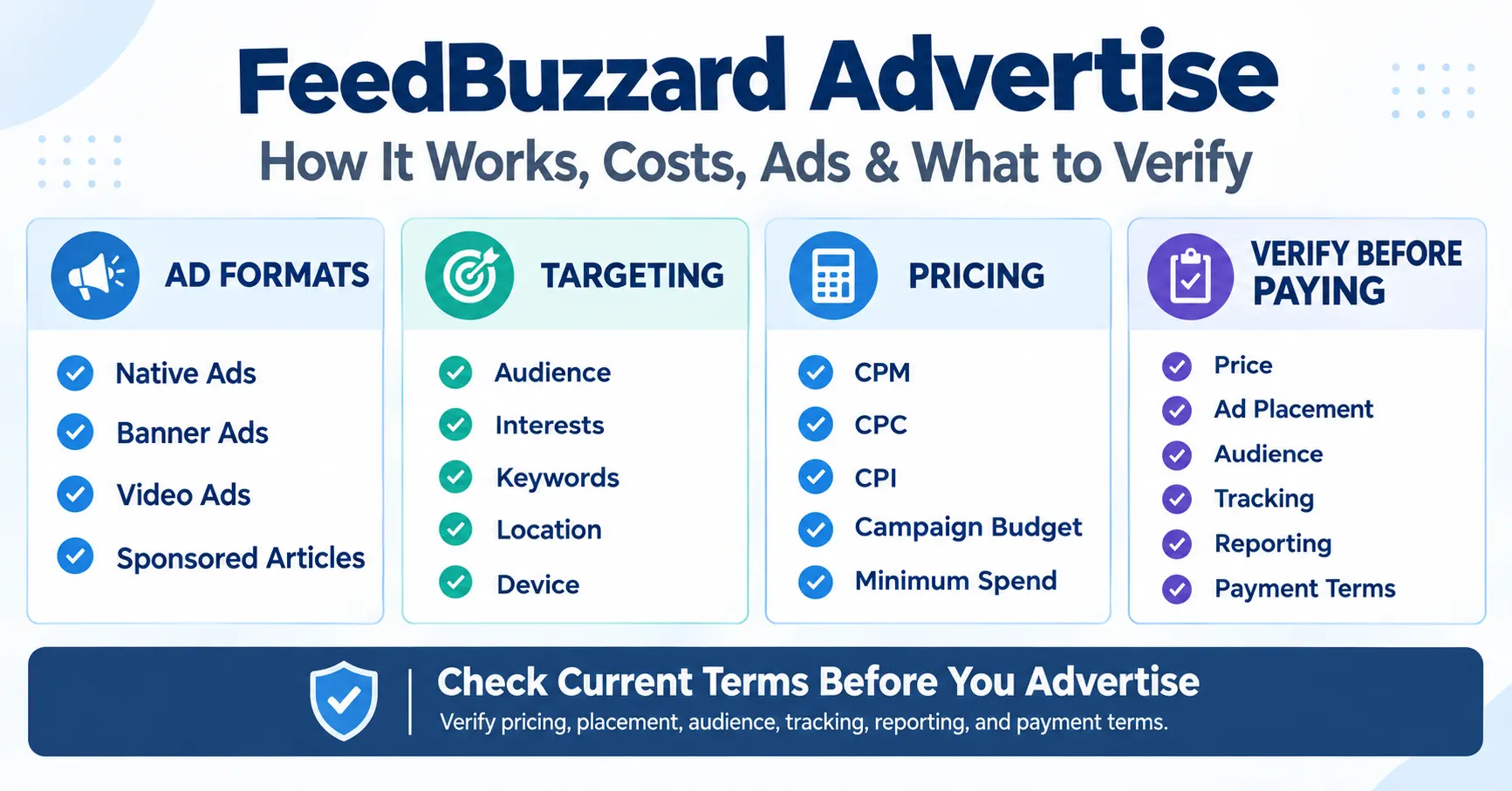
If you searched for “FeedBuzzard Advertise,” you are probably looking for more than a simple definition. You may want to know whether FeedBuzzard offers advertising, what types of ads are available, how an advertising campaign works, what pricing models are described, and which details you should verify before spending money.
The confusion comes from the fact that different FeedBuzzard pages describe advertising from slightly different perspectives. Its advertising guide discusses campaign-style advertising, including ad formats, targeting, budgets, pricing models, creative assets, and conversion tracking. Meanwhile, the FeedBuzzard About page primarily describes the website as a technology-focused publication.
That distinction matters if you are considering an advertising campaign. This guide explains what FeedBuzzard currently publishes about its advertising opportunities, how the described process works, what the different ad formats mean, and what you should confirm before making a payment.
What Does “FeedBuzzard Advertise” Mean?
FeedBuzzard Advertise generally refers to advertising or promotional opportunities associated with FeedBuzzard.com.
The site’s published advertising information describes a campaign-based model involving advertising formats, audience targeting, budgets, pricing models, creative assets, billing, and conversion tracking.
At the same time, FeedBuzzard’s main website presents itself as a technology-focused publication covering areas such as technology, world technology, and wearable technology.
When people search for FeedBuzzard Advertise, they may therefore encounter descriptions that make the service sound like a publisher advertising opportunity, a structured advertising platform, or a combination of the two.
The safest approach is to distinguish between what FeedBuzzard itself publishes and what can be independently verified.
What Does FeedBuzzard Advertise Include?
According to FeedBuzzard’s published advertising guide, advertisers can create campaigns around objectives such as traffic or conversions, select audiences and geographic limits, choose advertising formats, upload creative assets, set budgets, configure tracking, and submit campaigns for approval.
The guide also describes pricing models including CPM, CPC, and CPI.
These details represent FeedBuzzard’s published description of its advertising service. They should not automatically be interpreted as independently verified evidence of traffic volume, campaign performance, guaranteed conversions, or return on investment.
What FeedBuzzard Says About Its Advertising Service
The current FeedBuzzard advertising guide describes several parts of the advertising process.
These include:
- campaign objectives
- audience targeting
- geographic targeting
- advertising formats
- creative assets
- campaign budgets
- pricing models
- billing information
- conversion tracking
- campaign review
- campaign approval
This provides a useful starting point for understanding FeedBuzzard Advertise, but advertisers should still confirm the current commercial terms before making a payment.
Is FeedBuzzard a Publisher, Advertising Platform, or Both?
FeedBuzzard has characteristics of a content publisher because its main website publishes technology-focused editorial content.
Its advertising-related pages also describe structured campaign features such as targeting, budgets, ad formats, and conversion tracking.
A cautious description is therefore:
FeedBuzzard is a content website that publishes information describing advertising opportunities and campaign functionality associated with the site.
This avoids making a stronger claim than the available information supports.
Why FeedBuzzard Advertise Searches Can Be Confusing
Search results can contain different descriptions of FeedBuzzard advertising, especially when older pages and third-party articles are mixed with current first-party information.
Some descriptions may mention advanced advertising capabilities, data-driven targeting, campaign optimization, dashboards, or performance tracking.
Because advertising features and commercial terms can change, an older article should not automatically be treated as evidence that a particular feature or price is still available.
The practical rule is simple:
Use the latest first-party information as your starting point, then confirm the exact offer before paying.
How Does FeedBuzzard Advertise Work?
If you are researching FeedBuzzard Advertise because you want to launch a campaign, treat the process as a sequence of details that need confirmation.
FeedBuzzard’s published advertising information describes a process involving account creation, billing verification, campaign objectives, audience selection, ad-format selection, creative uploads, budget settings, conversion tracking, review, and approval.
The exact process available to you should be confirmed from the current advertising information.
How to Start a FeedBuzzard Advertise Campaign
Before creating a campaign, establish what you want to advertise and what result you want to achieve.
Possible objectives include:
- website traffic
- leads
- registrations
- conversions
- product promotion
- brand awareness
- content promotion
Your objective should determine the campaign format, tracking setup, and performance measurements.
Choose the Campaign Objective and Placement
A campaign designed to generate traffic should be evaluated differently from a campaign designed to generate sales.
For example:
Traffic campaign:
Measure visitors, clicks, engagement, and cost per click.
Lead campaign:
Measure qualified leads and cost per lead.
Sales campaign:
Measure purchases, revenue, conversion rate, and return on advertising spend.
Content campaign:
Measure qualified visitors, engagement, and actions taken after reading the content.
The campaign objective should be established before spending money.
Prepare the Creative and Tracking
FeedBuzzard’s published advertising information describes creative uploads and conversion tracking.
Before submitting your advertisement, confirm the current requirements for:
- image dimensions
- file type
- file size
- video format
- video duration
- landing-page URL
- tracking requirements
- campaign approval requirements
For measurement, use a properly configured analytics system or UTM-tagged campaign URL where appropriate.
This makes it easier to identify visitors generated by the campaign.
Confirm FeedBuzzard Advertise Terms Before Payment
This is one of the most important parts of the process.
Do not rely solely on a third-party article for a price, traffic figure, minimum budget, or performance promise.
Before paying, confirm:
- What advertising placement are you purchasing?
- How long will the campaign run?
- What is the total cost?
- Is there a minimum campaign budget?
- What audience will receive the advertisement?
- What reporting will be provided?
- How will clicks and conversions be measured?
- What happens if the campaign is rejected?
- What are the cancellation and refund conditions?
Keep a written record of the commercial terms.
What Ad Formats Does FeedBuzzard Advertise Describe?
FeedBuzzard’s published advertising guide describes several advertising formats. Availability and specifications should still be confirmed for the campaign you intend to run.
Native Advertising
Native-style advertising is designed to fit more naturally within a content or feed environment.
This format can be useful when the advertiser wants promotional information to appear within a content-focused experience.
However, sponsored or promotional material should remain clearly identifiable and comply with applicable advertising and disclosure requirements.
Banner Advertising
Banner advertising uses conventional display advertisements placed in designated areas of a webpage or feed.
Before preparing a banner, confirm:
- dimensions
- file type
- maximum file size
- placement
- campaign duration
- delivery measurement
Do not assume that specifications published in an older article are still current.
Video Advertising
FeedBuzzard’s advertising information also describes video advertising and discusses video creative requirements.
Before preparing a video advertisement, confirm:
- resolution
- aspect ratio
- maximum file size
- duration
- audio requirements
- thumbnail requirements
- placement
This can prevent an advertisement from being rejected because of outdated specifications.
Sponsored Articles
Sponsored articles are different from conventional display advertisements because the promotional material is presented in article form.
This can be useful when an advertiser wants to explain a product, service, technology, announcement, or resource rather than display a short advertisement.
Before ordering sponsored content, confirm how the article will be labeled and what editorial or disclosure requirements apply.
What Are FeedBuzzard Advertise Costs and Pricing Models?
One of the most common questions behind FeedBuzzard Advertise is cost.
FeedBuzzard’s published advertising information discusses pricing models such as CPM, CPC, and CPI.
However, a pricing model does not mean there is one universal price for every advertiser.
Actual campaign costs can depend on factors such as:
- advertising format
- placement
- campaign duration
- audience
- targeting
- budget
- current commercial terms
CPM Pricing
CPM means cost per thousand impressions.
The advertiser pays according to the number of impressions delivered.
A basic calculation is:
Estimated cost = Impressions ÷ 1,000 × CPM
For example, if a hypothetical campaign delivered 50,000 impressions at a hypothetical $5 CPM, the calculation would be:
50,000 ÷ 1,000 × $5 = $250
This is only a mathematical example and is not a claim about FeedBuzzard’s actual advertising rate.
CPC Pricing
CPC means cost per click.
A basic calculation is:
Cost per click = Total campaign cost ÷ Total clicks
If a campaign costs $200 and generates 500 clicks, the calculated CPC would be $0.40.
The actual FeedBuzzard campaign terms should be confirmed before purchase.
CPI Pricing
CPI commonly means cost per install, particularly for app-promotion campaigns.
If CPI is offered for a particular campaign, confirm exactly what counts as an install and how attribution and reporting work.
What Is Publicly Known About FeedBuzzard Advertising Prices?
FeedBuzzard describes CPM, CPC, and CPI pricing models, but advertisers should not assume that one number mentioned online represents the current price for every campaign.
Before paying, request the current:
- campaign cost
- pricing model
- minimum budget
- daily budget
- placement
- campaign duration
- additional fees
- payment schedule
- cancellation terms
- refund conditions
For commercial decisions, current terms are more useful than an old price mentioned in an unrelated article.
What Should You Verify Before Advertising on FeedBuzzard?
Understanding the advertising model is only the first step.
Before spending money on FeedBuzzard Advertise, verify the specific offer being presented to you.
Verify FeedBuzzard Advertise Pricing and Minimum Spend
Ask for the current price or pricing method in writing.
Do not assume that a number published by a third-party website remains valid.
Confirm:
- total campaign cost
- pricing model
- minimum budget
- daily budget requirements
- additional fees
- payment schedule
- refund policy
- cancellation policy
If the cost structure is unclear, ask for clarification before paying.
Verify the Audience and Traffic
A large number of impressions does not necessarily mean that an advertising campaign will generate useful customers.
Ask for information that helps you understand the relevant audience, such as:
- geographic distribution
- content categories
- device information where applicable
- expected impressions
- expected clicks, if available
- reporting method
Be cautious with unsupported traffic or audience numbers copied from third-party articles.
Instead of asking only:
“How much traffic does FeedBuzzard receive?”
ask:
“How much relevant traffic can this particular advertising placement reasonably deliver to my campaign?”
That is a more useful commercial question.
Verify the Ad Placement and Format
Ask exactly where your advertisement will appear.
A banner at the top of a page is different from a banner inside an article. A sponsored article is different from a conventional display advertisement.
Confirm:
- page or placement
- position
- format
- dimensions
- campaign duration
- expected visibility
- whether the placement is exclusive or shared
This makes the advertising purchase more clearly defined.
Verify Tracking and Reporting
Before launching a campaign, determine how performance will be measured.
Ask:
- Will impressions be reported?
- Will clicks be reported?
- Can tracking parameters be used?
- Are conversions tracked?
- How often is reporting available?
- What analytics information will be provided?
If your objective is sales or lead generation, click reporting alone may not be sufficient.
Verify Payment and Campaign Terms
Before payment, confirm:
- Who receives the payment?
- What service is included?
- When does the campaign begin?
- How long does it run?
- What happens if the campaign is rejected?
- What happens if the agreed placement is unavailable?
- Is there a cancellation or refund policy?
Keep copies of invoices, agreements, campaign details, and correspondence.
FeedBuzzard Advertise Claims That Need Independent Verification
Some claims can appear repeatedly across different websites without having independent evidence behind them.
Treat claims about the following as requiring verification unless supported by current, reliable evidence:
- exact monthly traffic
- exact audience size
- guaranteed conversions
- guaranteed ROI
- guaranteed sales
- fixed minimum deposits
- exclusive audience access
- exact campaign performance
- guaranteed advertising results
Repeated wording does not automatically make a claim independently verified.
How to Test and Measure a FeedBuzzard Advertising Campaign
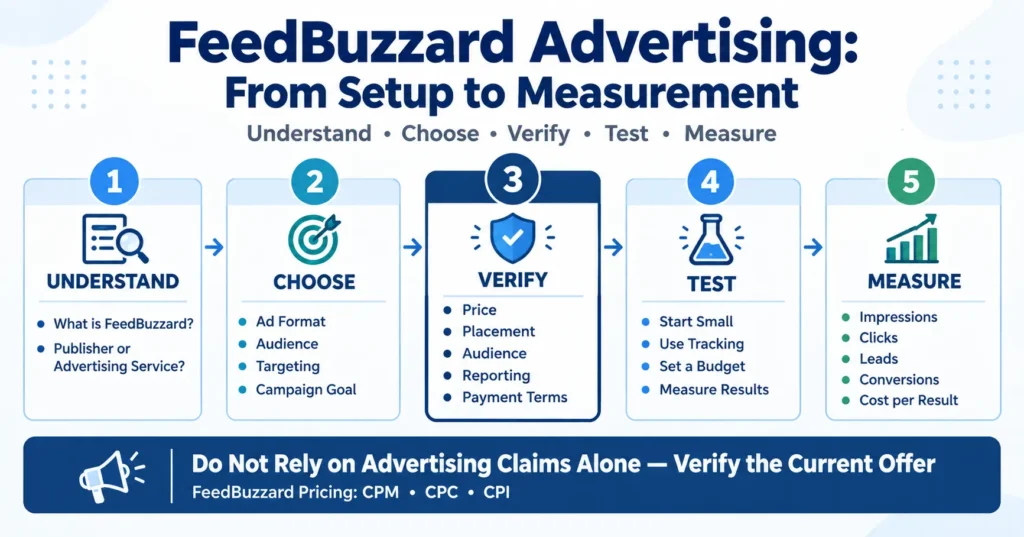
If you decide to advertise, a small measurable test can provide useful campaign evidence before committing to a larger budget.
The goal is not to assume a particular result. The goal is to determine whether a specific placement and audience produce results relevant to your business.
Set One Measurable Objective
Start with one primary goal.
Examples include:
- website visits
- email registrations
- product inquiries
- app installs
- purchases
- content engagement
Your objective determines which metrics matter.
Use Tracking Links and a Dedicated Landing Page
Send campaign visitors to a landing page designed for the advertisement.
Where appropriate, use UTM parameters so your analytics system can identify traffic generated by the campaign.
You can distinguish:
- source
- medium
- campaign
- advertisement variation
This makes campaign analysis easier.
Monitor Clicks, Leads, and Conversions
Do not stop at clicks.
A basic measurement chain is:
Impressions → Clicks → Visits → Leads → Customers → Revenue
Each stage provides different information.
A campaign can generate many clicks without producing meaningful leads or sales. In that situation, the issue could involve audience relevance, targeting, landing-page experience, offer quality, or conversion tracking.
Calculate Campaign Cost and Return
For a traffic campaign:
Cost per click = Total campaign cost ÷ Total clicks
For lead generation:
Cost per lead = Total campaign cost ÷ Total qualified leads
For sales:
ROAS = Revenue attributed to advertising ÷ Advertising cost
These measurements provide a more concrete way to evaluate the campaign than simply describing it as successful or unsuccessful.
Decide Whether You Have Enough Evidence to Scale
After the campaign test, compare the results with the objective established before launch.
Consider:
- Was the traffic relevant?
- Did visitors engage with the landing page?
- Did the campaign produce the intended action?
- Was the cost appropriate for your business model?
- Was reporting clear?
- Could the result be reproduced?
Use the evidence from the test to determine whether another campaign is worth considering.
Who Might Consider FeedBuzzard Advertising?
The relevance of an advertising placement depends on the relationship between the audience and the product being promoted.
Because FeedBuzzard describes itself as a technology-focused publication, technology-related advertisers may find its subject matter relevant.
That does not guarantee advertising performance. The actual campaign audience and placement should still be verified.
Technology and Digital Products
Potentially relevant products may include:
- software
- SaaS products
- technology services
- gadgets
- digital tools
- apps
The important question is whether the actual audience matches the product.
Content and Sponsored Promotion
A company promoting a technology guide, product announcement, research report, tutorial, or other useful resource may consider a content-focused advertising placement.
For sponsored content, confirm:
- labeling
- editorial requirements
- publication timing
- content length
- links
- revision requirements
- disclosure requirements
When Audience Fit Matters More Than Traffic Volume
A smaller relevant audience can sometimes be more useful to a campaign than a larger unrelated audience.
For example, a specialized developer tool may benefit more from relevant software-development readers than from a large general audience.
This is why advertisers should consider audience relevance, placement, measurable actions, and cost together.
FeedBuzzard Advertising vs. a Major Self-Service Ad Platform
Advertising directly through a publisher and advertising through a major self-service advertising platform are different models.
| Factor | FeedBuzzard Advertising | Major Self-Service Ad Platform |
|---|---|---|
| Buying process | Confirm the current process | Usually structured through an advertiser interface |
| Inventory | Associated with the publisher/site | Usually distributed across a larger network or ecosystem |
| Pricing transparency | Confirm current terms | Generally more standardized |
| Audience data | Verify what is available | Defined by the platform’s own systems |
| Reporting | Confirm available reporting | Usually built into the platform |
| Campaign testing | Useful for evaluating placement | Commonly supported |
| Placement control | Depends on the specific offer | Depends on platform and campaign settings |
This table is a factual comparison of advertising models rather than a ranking.
A publisher-specific placement may be evaluated primarily according to audience relevance and placement. A major self-service platform may provide a broader advertising ecosystem with its own targeting, inventory, measurement, and bidding systems.
The appropriate option depends on the campaign requirements.
FeedBuzzard Advertise FAQ
Is “FeedBuzzard Advertise” the Official Name of a Product?
The phrase is commonly used to describe advertising opportunities associated with FeedBuzzard.
FeedBuzzard publishes advertising information describing campaign formats, targeting, budgets, and pricing models.
The exact name and structure of an advertising product should be confirmed using the current first-party information before purchasing.
Does FeedBuzzard Publish Advertising Prices?
FeedBuzzard’s advertising information describes pricing models such as CPM, CPC, and CPI.
However, this does not establish one universal price for every advertiser or campaign.
Ask for the current price, minimum budget, placement, campaign duration, and commercial terms before paying.
Can You Advertise a Technology Product on FeedBuzzard?
FeedBuzzard describes itself as a technology-focused publication, so technology-related products may be relevant to its content environment.
However, relevance does not guarantee campaign performance. The actual advertising audience and placement should be confirmed.
How Can You Verify a FeedBuzzard Advertise Offer?
Start with the current information published on FeedBuzzard’s website.
Then confirm:
- price
- placement
- audience
- campaign duration
- reporting
- tracking
- payment terms
- cancellation conditions
Avoid relying only on a third-party article for commercial information.
Should You Trust FeedBuzzard Advertising Specifications Found on Third-Party Websites?
Use third-party information as supplementary research rather than the final authority.
Advertising specifications can change, and older articles may contain outdated information.
When possible, verify the current specifications directly with FeedBuzzard.
Final Takeaway
The search term “FeedBuzzard Advertise” points to a practical question: how can you understand and evaluate the advertising opportunity associated with FeedBuzzard before spending money?
FeedBuzzard’s published advertising information describes campaign formats, targeting, budgets, pricing models, and tracking capabilities. Its main website also describes FeedBuzzard as a technology-focused publication.
The key distinction is between what FeedBuzzard publishes about its advertising service and what can be independently verified about a particular campaign.
If you are considering FeedBuzzard Advertise, confirm the current placement, audience, pricing, minimum spend, tracking, reporting, payment terms, and cancellation conditions before paying.
Then use a measurable campaign test rather than relying on general claims about traffic or performance.
This approach gives you a practical way to understand exactly what is being offered, what you are paying for, how the campaign will be measured, and whether the resulting traffic or conversions provide enough evidence to continue.


Comments are closed