



If you’ve seen “UpToDate AI” mentioned by a doctor, in a hospital newsletter, or in an app store listing, you might have no idea what it actually does. You’re not alone. It sounds like it could be a general AI chatbot with a medical theme, but it isn’t. That distinction matters if you’re trying to decide whether it’s worth your time, your subscription dollars, or your trust.
Here’s the short version before we go deeper. UpToDate AI (officially UpToDate Expert AI) is a conversational AI layer built on top of UpToDate, the clinical reference tool doctors and hospitals have used for decades. It doesn’t browse the internet or make things up the way a general chatbot can. Instead, it answers questions using only UpToDate’s own expert-written medical content. This review covers what it does, what it costs, real user complaints, and how it compares to other clinical AI tools before you subscribe.
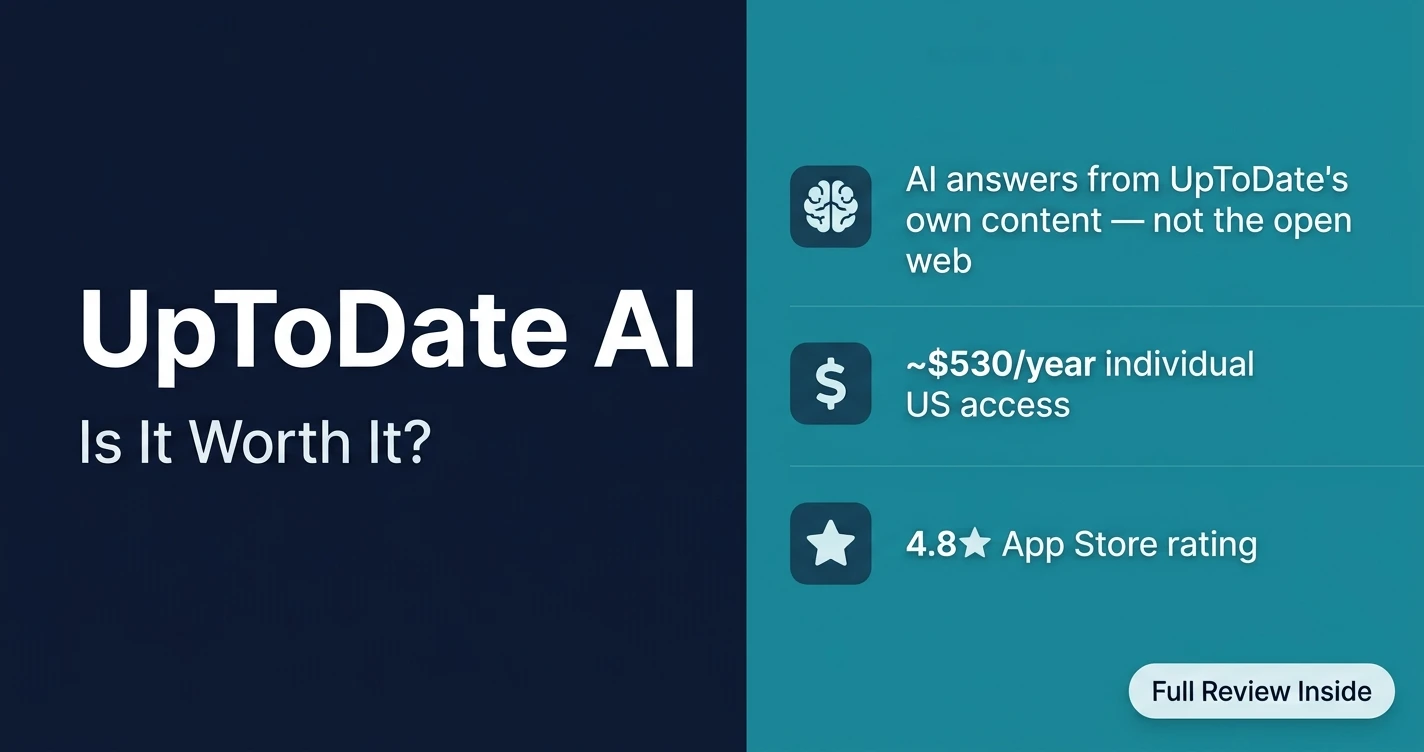
Quick Answer: UpToDate AI (UpToDate Expert AI) is a generative AI search feature inside the UpToDate clinical decision support platform. It lets healthcare professionals ask medical questions in plain language and get answers sourced only from UpToDate’s own peer-reviewed content, not the open web.
What UpToDate AI Actually Is
UpToDate has been a reference tool for years. Doctors use it to look up disease information, treatment guidelines, and drug details at the point of care. More than 3 million healthcare professionals rely on it daily to support patient care.
UpToDate Expert AI sits on top of that existing library. Instead of typing keywords and scrolling through a topic page, you ask a full question the way you’d ask a colleague. The system then searches its own database and builds an answer. According to Wolters Kluwer’s own product page, it combines the company’s evidence-based content with generative AI technology, so it can handle complex, specific clinical questions and explain its reasoning and sources along the way.
The key difference from ChatGPT or a general AI search tool comes down to where the answers originate. UpToDate applies generative AI strictly to the knowledge already stored in its own database — it doesn’t pull from the open internet. That’s a deliberate design choice, and it’s the main reason clinicians trust it more than a general chatbot for medical questions.
How UpToDate Expert AI Builds an Answer
Type a question into UpToDate Expert AI, and you don’t just get a paragraph to trust blindly. Every response comes with clickable access to the assumptions behind it, the exact UpToDate source content, and the step-by-step reasoning the system used. You can check its logic instead of taking it on faith.
That transparency drives the whole pitch. The tool doesn’t rank pages like a search engine — it emulates how an experienced clinician reasons through a problem. It weighs evidence, checks assumptions, and connects them to a specific scenario. It also pulls in drug information directly. Ask about a medication’s dosing or interactions, and you won’t need to dig through a separate monograph; the tool surfaces the relevant details and uses structured tables to compare options like differential diagnoses.
Is UpToDate AI Accurate — and Can You Trust It?
This is the question that matters most, so let’s answer it honestly instead of repeating the marketing.
The strongest argument in its favor is the closed data source. Most clinical AI tools run on similar underlying technology — retrieval-augmented generation. What actually separates them is the quality of the material they retrieve from. Tools grounded in curated, expert-reviewed content like UpToDate tend to produce more reliable output than ones drawing from the open web. It isn’t smarter than other AI models. It’s just working from a narrower, better-vetted pile of source material, which lowers the risk of confidently wrong answers.
Wolters Kluwer’s own leadership has been candid about why this matters. In an interview with Newsweek, the company’s chief medical officer pointed out that general-purpose AI models give inconsistent results. Search the same phrase twice, and you can get a different answer. Phrase a question slightly differently, and the result can change entirely. Closing the model off from the broader web aims to eliminate that kind of hallucination risk.
Still, lower risk isn’t zero risk. Real user reviews (more on those below) show it can stumble on specific clinical details. Treat it like any reference tool: a strong starting point that speeds up research, not a replacement for clinical judgment.
Who Can Actually Use UpToDate Expert AI Right Now
This isn’t a consumer app you casually download and start using. Access ties directly to your UpToDate subscription type. Right now, Expert AI is available through personal trainee subscriptions and UpToDate Pro Plus subscriptions in the US, plus select Enterprise Edition accounts. Feature access varies depending on your specific account.
It targets a professional audience, not a general one. The tool lets clinicians ask questions the way they think and get fast, evidence-based answers grounded in UpToDate’s content. It isn’t meant for patients researching their own symptoms. If you’re not a licensed healthcare professional or a student in a clinical program, skip this one — a general symptom checker or a conversation with your own doctor serves you better.
Students and residents get an extra perk worth knowing. Colleges and associations accredit UpToDate as a continuing education resource, so using it can count toward CME, CE, or CPD credit. That credit isn’t available on trainee-rate subscriptions, though.
What Does UpToDate AI Cost?
There’s no single published price, since cost depends on subscription tier and region. But industry pricing roundups give a useful benchmark: individual US access runs roughly $530 per year, with separate institutional pricing for organizations in markets like the UK.
Check for a professional-association discount before paying full price. Some associations negotiate member discounts on personal UpToDate and Pro Plus subscriptions — professional members can save around 20%, and student members up to 50% in some programs. And if your hospital or university already carries an Enterprise Edition license, you may already have access at no extra personal cost. Check with your IT or library department first.
How UpToDate AI Compares to Other Clinical AI Tools

UpToDate isn’t the only clinical AI tool on the market, and it isn’t automatically the right fit for every situation.
OpenEvidence is free for any verified licensed clinician and runs on a question-driven, evidence-synthesis model. It withdrew from the EU and UK in April 2026, though, which limits it mostly to US-based clinicians. DynaMed’s AI layer, Dyna AI, was the first mover into commercial AI deployment and puts a strong emphasis on transparent, evidence-graded methodology. ClinicalKey AI leans on the deepest textbook and journal library of the group. AMBOSS targets students, residents, and clinicians who want AI search tied into a broader learning platform rather than a pure point-of-care reference. Vera Health searches more than 60 million peer-reviewed papers and stays free for any licensed clinician worldwide, giving it stronger global and multilingual reach than the paywalled, US-centric options.
UpToDate still wins on depth and reputation. It remains a benchmark for editorial depth, built on physician-authored reference content with a conversational AI layer on top. That depth suits teams that prioritize deep reference material over a fast, standalone-answer workflow. Where it loses ground is accessibility — it’s the most expensive option here, and access still depends on your subscription tier.
What Real Users Say About UpToDate Expert AI
App Store reviews tell a more mixed story than the official marketing pages, and that mix is worth knowing before you rely on the tool heavily.
On the positive side, it rates well overall. It holds a 4.8-star rating from nearly 1,900 App Store reviews. Users describe it as their go-to AI specifically because it keeps them inside a tool they already trust, instead of switching to a general AI model.
The complaints that do show up are specific and worth taking seriously. One detailed review described the tool failing to identify the active ingredients in a combination medication, even after the user supplied the exact drug name and dosage — a general AI model answered the same question in seconds. Other reviewers flagged slow response times and said the tool sometimes needs several follow-up prompts before it gives a useful answer. A few called it unfinished, which tracks with its beta-stage status.
None of this makes the tool unreliable. It does mean you shouldn’t treat a fast answer as a complete one, especially on drug-specific questions.
The Limitations Nobody Mentions in the Marketing
A few honest caveats worth knowing going in:
- It’s reference-first, not workflow-first. You still ask a question against the UpToDate library, then manually translate what you learn into your own documentation or chart. It doesn’t work directly inside an EHR yet.
- It doesn’t handle personal patient data the way a secure clinical system does. Treat it as a knowledge lookup tool, not a place to paste identifiable patient information.
- It arrived later than some competitors. UpToDate Expert AI launched in September 2025 — notably later than AI-native competitors like OpenEvidence, which had already built a following by then.
- The rollout came in stages, not all at once. Wolters Kluwer launched it to an initial group of roughly 250,000 users across North America, with wider availability rolling out in phases since.
Getting the Most Out of UpToDate Expert AI
If you already have access, or you’re deciding whether to get it, a few habits make a real difference:
- Ask full clinical questions, not keywords. Phrase it the way you’d ask a colleague, and you’ll get sharper answers.
- Click through to the source every time. Every answer links back to the underlying UpToDate topic and reasoning — check that link before acting on anything drug- or dosage-related.
- Double-check drug-specific answers separately. Given the documented gaps around combination-drug components, cross-check medication questions against the full monograph.
- Check your existing access first. Your hospital, university, or professional association may already cover a license.
- Use it to speed up research, not replace judgment. It works best as a faster way to search content you’d already trust.
Frequently Asked Questions
Q: Is UpToDate AI the same as ChatGPT with a medical focus?
A: No. It only draws on UpToDate’s own expert-authored content, not the open internet. That’s the main reason clinicians treat it differently from a general chatbot.
Q: Can patients use UpToDate Expert AI?
A: It targets licensed healthcare professionals and clinical students, not patients researching their own symptoms. Patients are better served talking to their own provider or using a consumer-focused health tool.
Q: Q: Does it replace the regular UpToDate subscription?
A: No. It layers on top of certain existing subscription tiers — personal trainee, Pro Plus, and select Enterprise accounts. It isn’t a standalone product.
Q: How is it different from OpenEvidence or DynaMed’s AI?
A: They run on different content libraries and business models. OpenEvidence is free for verified US clinicians, DynaMed’s Dyna AI emphasizes evidence grading, and UpToDate leans on its decades-deep, physician-authored topic library as its main edge.
Q: Is it still in beta?
A: Some user reviews describe it as an early-stage release, and Wolters Kluwer has kept expanding access in phases since launch rather than releasing everything at once.
The Bottom Line
UpToDate AI isn’t trying to be a general-purpose AI assistant. It’s a faster, conversational way to search a medical reference library clinicians already trust. That narrow focus is exactly what makes it useful: fewer surprises, clearer sourcing, answers you can trace back to their origin. It isn’t perfect — the drug-recognition misses and slower response times reported by real users are worth remembering. But for the professionals it’s built for, it solves a real problem: getting a trustworthy answer faster, without leaving the reference tool they already rely on.


Comments are closed