



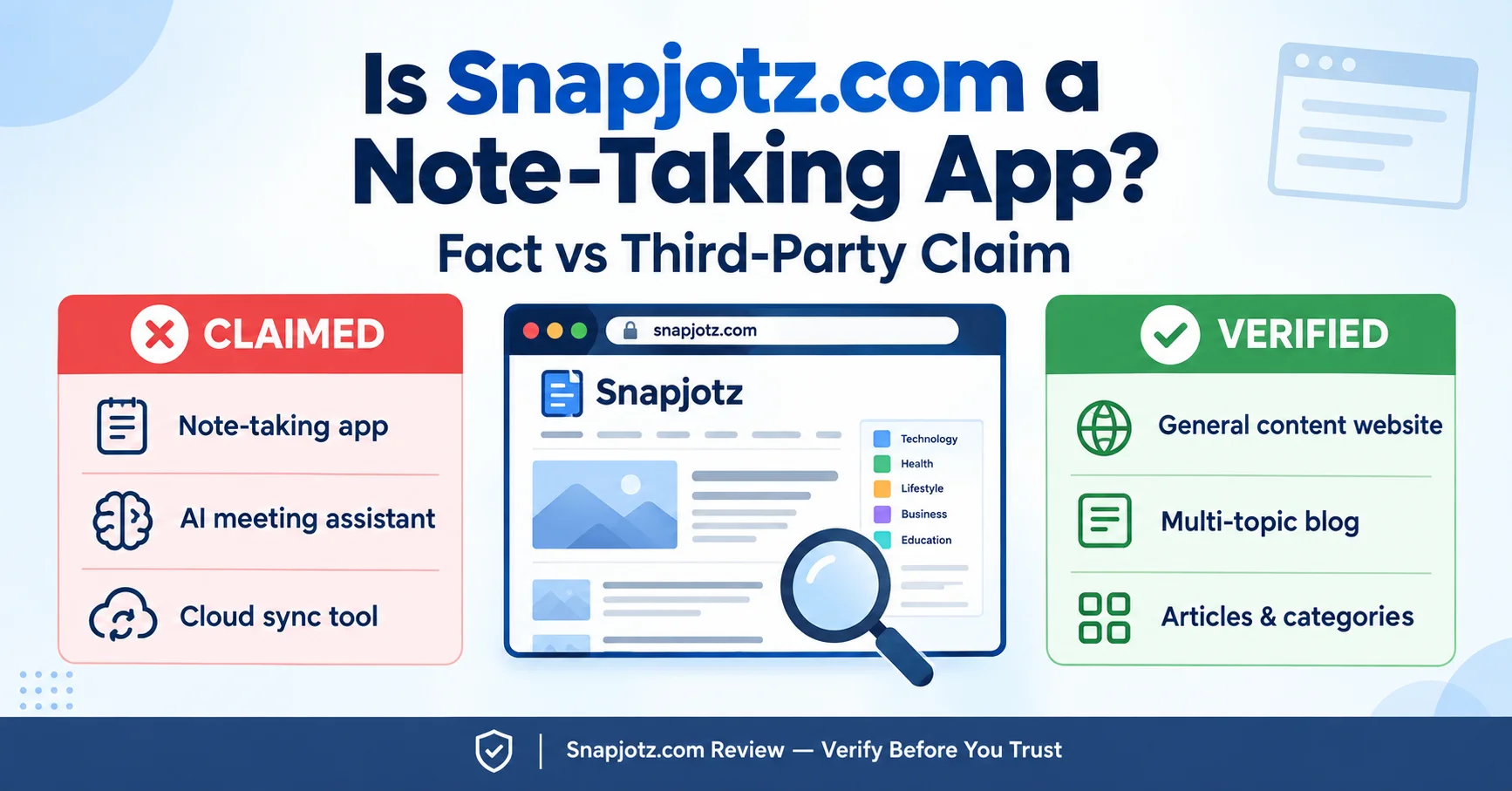
Search for “Snapjotz.com” and you’ll quickly notice something odd: the results don’t agree on what it is. Some pages call it a note-taking or productivity tool. Others describe it as a general content website. That inconsistency matters, because the specific domain you land on determines what you’re actually looking at. Rather than trusting whatever description shows up first, it’s worth separating the exact site from claims made about it elsewhere — then checking what actually holds up.
What Is Snapjotz.com Actually?
Based on the publicly available evidence, Snapjotz.com looks like a multi-category content website, not a documented software product. It’s structured like a blog — articles spanning different subjects — rather than something resembling an app dashboard.
That’s the first thing to understand if you came here expecting software.
A genuine software product usually signals itself clearly: an account sign-up flow, documentation, pricing, a dashboard, a download, or at least a plain explanation of what it does. Snapjotz.com doesn’t show these markers. Instead, reviewers describe it as covering topics like business, education, entertainment, fashion, finance, health, gaming, real estate, sports, and travel — the hallmarks of a publishing site, not a productivity platform.
What the Snapjotz.com Evidence Shows
The clearest way to judge Snapjotz.com is by what it visibly does, not by what its name suggests.
A site built around articles, categories, author pages, and archives behaves very differently from a platform where users log in and manage their own data. And that distinction matters here specifically because the name “Snapjotz” naturally evokes quick notes or digital journaling — even though a name alone tells you nothing about what a site actually offers.
Independent reviews of the domain describe it as article-based, and they note the absence of any documented features you’d expect from real note-taking software.
Snapjotz.com: Fact vs Third-Party Claim
There’s a real difference between:
“A website describes Snapjotz as a note-taking platform”
and
“Snapjotz.com is a verified note-taking platform.”
The first is a statement about something published somewhere else. The second is a factual claim about what this specific domain actually offers.
So it helps to sort any information about Snapjotz into four buckets:
- Verified fact — what the site itself visibly shows
- Third-party claim — what some other website says about it
- Interpretation — a reasonable reading of the available evidence
- Unverified — a claim without enough evidence to confirm
This matters because search results for the same query currently describe wildly different things.
Why Do Snapjotz.com Descriptions Vary So Much?
The core reason for the confusion is that different pages in search results simply disagree. Some call Snapjotz a cloud notebook, an AI meeting assistant, or a digital workspace. Others — looking specifically at the .com site — describe a general-interest blog.
That leaves anyone searching the name with an obvious question: which version should you trust?
The answer isn’t about which description sounds more convincing — it’s about whether the claim can actually be traced back to the exact domain in question.
Why Repeated Snapjotz Claims Aren’t Proof
Imagine five different sites all describe Snapjotz as an AI note-taking app. That might look like solid evidence purely because the claim keeps showing up. But if those five sites are all just echoing each other, repetition doesn’t add independent verification.
For a real software product, you’d typically expect to find:
- An official product page
- A working sign-up flow
- Documentation
- Clear feature descriptions
- Pricing details
- Privacy/data-handling policies
- Screenshots or demos
- Support channels
Missing one of these doesn’t automatically mean a product is fake. But when a whole cluster of claims can’t be matched to what the domain actually shows, those claims deserve skepticism rather than acceptance. One review reaches the same conclusion: the visible .com site reads as an article hub, which makes the productivity-tool claims hard to substantiate.
The Snapjotz Domain-Name Confusion
There’s an added layer of confusion here: a search for “Snapjotz” doesn’t point to one single entity. Different domains can share similar names while having entirely different owners and purposes.
For instance, both snap-jotz.com (hyphenated) and snapjotz.org exist as separate sites with their own content. The hyphen, the extension, and the full URL all matter — seeing the word “Snapjotz” somewhere doesn’t mean it’s describing Snapjotz.com specifically.
This becomes especially important if a site is asking you to create an account, upload data, download software, or link another account — always confirm the complete domain first. Tools like ICANN’s WHOIS Lookup can help you check who actually registered and operates a given domain.
Is Snapjotz.com a Note-Taking or AI Tool?
This is probably the question that brought most people here.
What outside sources claim: Several third-party pages associate the Snapjotz name with productivity features — cloud sync, multimedia notes, organization tools, collaboration, even AI meeting transcription. These are all plausible features for modern software. The issue isn’t whether they could exist — it’s whether they can be tied to the actual Snapjotz.com domain.
What the evidence actually supports: It doesn’t establish Snapjotz.com as a documented note-taking or AI tool. Instead, the domain is consistently described as a general content site with multiple topic categories. So features mentioned elsewhere shouldn’t automatically be assumed to apply here — always check the claim against the actual site first.
If You Were Looking for a Note-Taking App
Don’t assume that finding the Snapjotz name means you’ve found the tool you wanted. A legitimate note-taking service should clearly explain:
- How notes get created
- Where they’re stored
- Whether you need an account
- How syncing works
- What happens to your data
- Whether you can export notes
- How privacy and security are handled
These aren’t small details — they matter a lot if you’re planning to store personal notes, work files, or meeting records.
For now, the most accurate summary is: Snapjotz.com presents itself as a content website; claims that it’s a fully documented note-taking or AI platform remain unverified.
One Simple Test
Whenever you see a claim about Snapjotz, ask: “Is this coming from the actual Snapjotz.com site, or is another website just describing it?”
If it’s the latter, treat it as a third-party claim until you can trace it back to primary evidence. This one habit prevents a common trap: information about one brand or domain slowly getting repeated as if it were official fact about a different one.
Are Other Snapjotz Domains the Same as Snapjotz.com?
No. Don’t assume every Snapjotz-branded site is the same service. This is one of the easiest ways to get confused.
Snapjotz.org, for example, presents itself as an independent publication covering tech, AI, apps, and online services — that’s not the same as assuming its content describes the .com site. Similarly, snap-jotz.com has its own separate content and should be evaluated independently.
Why the Exact Domain Matters
Say you find a page claiming “Snapjotz provides AI meeting summaries,” then visit a different Snapjotz domain that turns out to be a content site. It’s tempting to assume the first page was describing the second site — but that assumption could easily be wrong.
Before trusting any feature or company claim, check:
- The exact extension (.com, .org, etc.)
- Whether there’s a hyphen
- Exact spelling
- The site’s About/Contact pages
- Whether the claimed feature actually appears there
- Whether documentation links back to that same domain
This matters most when a site is asking for an account, a download, payment, or personal data.
Is Snapjotz.com Safe to Browse?

There’s a difference between “this site is operating” and “everything on it is automatically safe.”
Snapjotz.com does appear to be an active, functioning content site — but that alone doesn’t guarantee every link, ad, or claim on it is trustworthy. A practical safety approach works better than a simple safe/unsafe label. Resources like the FTC’s guide to avoiding online scams offer general principles that apply well here.
HTTPS Isn’t a Trust Seal
A padlock icon means your connection is encrypted — nothing more. It doesn’t confirm:
- The site is reputable
- Every article is accurate
- The operator is trustworthy
- Any advertised product is legitimate
- A download is safe
- Claims are independently verified
Treat HTTPS as one small signal, not proof of trustworthiness.
Be Extra Cautious With Downloads and Forms
Reading an article carries different risk than downloading a file or submitting personal information. Before downloading anything, ask:
- Do I actually need this?
- Is it clearly provided by the site itself?
- What file type is it?
- Is the page transparent about what it does?
- Does it come from a different domain?
- Does my browser/security software flag it?
Same logic applies to forms — don’t hand over sensitive information just because a page asks for it.
Checklist Before Using Snapjotz.com
1. Confirm the exact URL. Make sure you’re on snapjotz.com specifically — not a lookalike domain.
2. Judge it by what it actually shows. Check the homepage, navigation, About page, contact info, and any login/signup areas. Current reviews describe it as a general-interest publication, not a software dashboard.
3. Verify important claims independently. If an article makes a significant claim — about a product, company, health topic, or legal matter — don’t rely on a single blog post. Trace it to a primary source.
4. Check ownership and contact details. Limited transparency doesn’t automatically mean fraud, but it does make independent verification harder — weigh it alongside other signals. A quick WHOIS lookup can clarify who actually registered the domain.
5. Be cautious with personal information. If you’re just reading, you likely don’t need to submit anything. Ask why a form needs what it’s asking for.
6. Don’t confuse an article with an official product page. A third-party site saying “Snapjotz has AI transcription” is not the same as an official Snapjotz page documenting that feature.
What Can You Conclude About Snapjotz.com?
| Question | Evidence-based answer |
|---|---|
| Does the domain exist? | Yes |
| What does it appear to be? | A general content/publishing site |
| Is it a confirmed note-taking app? | Not established by current evidence |
| Why the confusion? | Different sources attach different descriptions to the name |
| Are there similarly named domains? | Yes |
| Should claims from those be attributed to .com? | No |
| Does HTTPS prove trustworthiness? | No |
| Should big claims be independently checked? | Yes |
Keep in mind, too, that websites change. Ownership shifts, redesigns happen, services migrate to new domains — so older descriptions shouldn’t be assumed to reflect the current state of the site. That’s why both the date of the evidence and the exact domain matter.
FAQ
Does Snapjotz.com have an official note-taking app?
Current evidence doesn’t establish one. Some outside sources make productivity-related claims, but those shouldn’t be assumed to apply to the .com domain.
Why do some sites call it an AI productivity tool?
The name has picked up inconsistent descriptions online, partly due to similarly named domains and partly due to sites repeating each other’s claims. The .com site itself presents as content-focused.
Is Snapjotz.com the same as Snapjotz.org?
Treat them as separate unless there’s clear evidence of shared ownership. Snapjotz.org presents itself as an independent tech publication.
Is Snapjotz.com a scam?
Nothing in the current evidence supports that label — it appears to be an operating content site. Still, verify the domain, check what it offers, and be cautious before submitting data or downloading files.
Can everything on Snapjotz.com be trusted?
No site should be treated as an automatic authority. For casual reading, evaluate sourcing. For anything important, verify against primary sources.
Why does the exact domain matter so much?
Because similarly named sites can be completely unrelated. Mixing them up means applying the wrong features, ownership, or safety assumptions to the wrong website.
The Bottom Line on Snapjotz.com
If you searched “Snapjotz.com” wanting to know what it actually is, the confusion boils down to a mismatch between the real .com domain and the many different descriptions attached to the “Snapjotz” name elsewhere online.
Current evidence points to Snapjotz.com being a multi-topic content site — not a documented note-taking or AI productivity tool. That doesn’t mean every older reference to a “Snapjotz” product was fabricated; domains get repurposed, and similarly named services can exist independently.
The practical takeaway: verify the exact domain before trusting any feature list, product claim, or recommendation tied to it. If you’re just reading, focus on checking sourcing. If you’re about to sign up, download something, or share personal data, take the extra step — confirm who runs the site, what it actually offers, and why it’s asking for your information.


Comments are closed