



Many people search for the meaning of life because they are looking for more than a simple definition. They want to understand why they exist, what makes their experiences valuable, and how they can build a life that feels purposeful.
The meaning of life is not always about finding one universal answer that applies to everyone. For some people, it is connected to relationships, personal growth, helping others, creativity, spirituality, achievements, or discovering their own values.
If you are wondering what the meaning of life really is, why people search for purpose, or how you can create more meaning in your own life, this guide will help you understand the question step by step.
What Does the Meaning of Life Really Mean?
The meaning of life refers to the purpose, value, or significance that a person gives to their existence. It explains what makes life feel important and what motivates someone to continue learning, experiencing, growing, and contributing.
This question has been discussed by philosophers, scientists, religious thinkers, and ordinary people for thousands of years because it connects with a fundamental human desire: understanding our place in the world.
However, the meaning of life is not necessarily something everyone discovers in the same way. One person may find meaning through family and relationships, while another may find it through knowledge, creativity, career, service, or personal challenges.
The important idea is that meaning is often created through the way we live, not only discovered as a hidden answer.
Why Do People Search for the Meaning of Life?
People often start thinking deeply about the meaning of life during moments of change, uncertainty, success, loss, or personal reflection.
Common reasons include:
- Feeling that daily routines lack purpose
- Wondering whether achievements alone bring happiness
- Searching for personal direction
- Experiencing major life changes
- Trying to understand happiness and fulfillment
- Thinking about human existence and purpose
For example, someone may achieve career success but still feel empty because their goals were based only on external expectations. Another person with a simpler lifestyle may feel fulfilled because their actions match their personal values.
This shows that meaning is not only about what people achieve; it is about why they choose their actions.
Is There One Universal Meaning of Life?
A common question is whether humanity has one single answer to the meaning of life.
Different areas of thought approach this question differently.
Philosophical Views
Philosophers have explored whether meaning comes from human nature, personal choices, morality, knowledge, or individual responsibility.
Some philosophical perspectives suggest that life does not come with a fixed meaning, and people create meaning through their choices and actions.
Religious and Spiritual Views
Many religious traditions connect the meaning of life with faith, spiritual development, serving others, understanding creation, and living according to moral principles.
For believers, meaning may come from their relationship with a higher power and following spiritual teachings.
Scientific Perspective
Science usually studies life through biology, evolution, psychology, and human behavior rather than assigning a universal purpose. From a scientific perspective, humans naturally search for meaning because having goals, relationships, and a sense of purpose can influence motivation and emotional well-being, as explored by Psychology Today.
The Difference Between Meaning and Purpose

Although people often use these words together, meaning and purpose are slightly different.
Meaning explains why something matters.
Purpose provides direction and guides actions.
For example:
- A person may find meaning in supporting their family.
- Their purpose may be building a career that allows them to provide stability.
Meaning gives value to experiences, while purpose helps transform values into actions.
How Can You Find Meaning in Your Own Life?
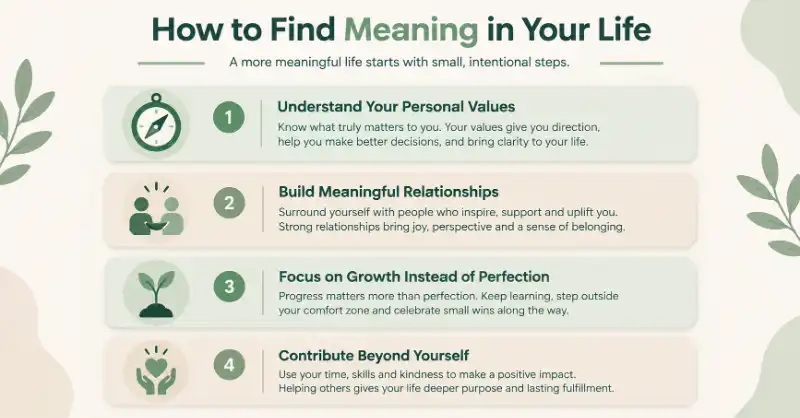
Finding meaning is usually a personal process. It develops through understanding yourself, making intentional decisions, and creating connections with the world around you.
Understand Your Personal Values
Your values are the principles that matter most to you.
Ask yourself:
- What activities make me feel fulfilled?
- What type of person do I want to become?
- What problems or causes do I care about?
- What would I continue doing even without recognition?
Understanding your values helps you identify what gives your life importance.
Build Meaningful Relationships
Relationships are one of the strongest sources of meaning for many people.
Family, friendships, communities, and meaningful connections create feelings of belonging and contribution.
A meaningful life is not only about personal success; it is also about the positive impact you have on others.
Focus on Growth Instead of Perfection
Many people believe they need to discover one perfect purpose before they can live meaningfully.
In reality, meaning often develops through learning, improving, and adapting.
Personal growth helps people create stronger connections with their goals and experiences.
Contribute Beyond Yourself
Helping others is another common way people experience meaning.
This can happen through:
- Supporting family members
- Sharing knowledge
- Volunteering
- Creating useful work
- Helping solve problems
Contribution creates a feeling that your life has value beyond yourself.
Can Meaning in Life Change Over Time?
A person’s understanding of meaning can change as they grow and experience different stages of life.
A young person may find meaning through exploration and learning. Later, their priorities may shift toward family, career, responsibility, creativity, or helping others.
Changing your understanding of meaning does not mean losing your purpose. It often means your perspective is developing.
Important life experiences that can change your sense of meaning include:
- Starting a new career
- Building relationships
- Becoming a parent
- Facing challenges
- Recovering from difficult experiences
- Discovering new interests
Meaning is an ongoing journey rather than a final destination.
Why Do Some People Feel Their Life Has No Meaning?
Feeling that life has no meaning is a common human experience, especially during difficult periods.
This feeling may happen when:
- Daily activities do not match personal values
- Someone focuses only on external success
- They compare their life with others
- They lose connection with important relationships
- They lack clear goals
This does not necessarily mean life has no meaning. It may be a sign that a person needs to reflect on what truly matters.
A helpful question is:
“What matters to me, and are my current choices moving me closer to it?”
Small changes based on personal values can gradually create a stronger sense of purpose.
Does Success Create Meaning in Life?
Success can be part of a meaningful life, but success alone does not always create fulfillment.
Money, recognition, and achievements may provide comfort, but they do not always answer deeper questions about happiness and purpose.
A meaningful life often combines success with:
- Personal growth
- Strong relationships
- Contribution
- Learning
- Experiences that feel valuable
Success becomes more meaningful when it supports the things that truly matter.
How Do You Create a More Meaningful Life?
A meaningful life is built through everyday choices.
Identify What Matters Most
Reflect on:
- What makes you feel alive?
- What responsibilities feel important?
- What impact do you want to create?
- What qualities do you admire?
These answers can reveal your personal sources of meaning.
Set Goals Connected to Your Values
Goals become more meaningful when they represent what you truly believe is important.
Instead of choosing goals only for approval or status, choose goals that match the person you want to become.
Accept Challenges as Part of Growth
A meaningful life does not mean avoiding difficulties.
Challenges can help you:
- Build resilience
- Learn new skills
- Discover strengths
- Reconsider priorities
Growth often happens through difficult experiences.
Common Misunderstandings About the Meaning of Life
“There Must Be One Correct Answer”
Different people can find meaning through different beliefs, experiences, and values.
“Meaning Only Comes From Big Achievements”
Meaning can also come from small actions such as caring for others, learning, creating, and improving yourself.
“You Must Find Purpose Before Taking Action”
Many people discover purpose by exploring, trying new things, helping others, and learning from experiences.
Frequently Asked Questions About the Meaning of Life
What is the simplest definition of the meaning of life?
The meaning of life is the value, purpose, and significance that a person gives to their existence.
Is the meaning of life the same for everyone?
No. Different people find meaning through relationships, beliefs, creativity, work, personal growth, and contribution.
Can people create their own meaning in life?
Yes. Many perspectives suggest that people create meaning through their choices, actions, and values.
Why is finding meaning important?
A sense of meaning can provide direction, motivation, resilience, and a stronger connection with life.
What should I do if I feel my life has no purpose?
Start by reflecting on your values, reconnecting with important relationships, setting meaningful goals, and exploring activities that create contribution.
Final Thoughts: Meaning of Life Is Created Through How You Live
The meaning of life is not only a question about existence; it is also a question about how we choose to live.
People often search for one perfect answer, but meaning is usually created through everyday choices, relationships, personal growth, and contribution.
A meaningful life is not defined only by achievements. It is shaped by the connections you build, the person you become, and the positive value you bring to others.
Instead of waiting for meaning to appear as a final answer, focus on understanding what matters to you and living according to those values.


Comments are closed